Using prototyping to transform fragmented data into a mobile sales advantage.
Role

Principal Product Designer

Focus

Rapid Prototyping

Qualitative Research

Product Strategy

Impact

Uncovered organizational data issues

Validated key opportunities to address user pains

Overview

Bridging the Data Gap with High-Fidelity Prototyping

When data is fragmented, confidence erodes. Dealership salespeople were struggling to provide accurate information to customers because the "source of truth" was scattered across legacy systems. I led the design and research for a mobile-first solution that consolidated individual vehicle data into a single, high-performance sales tool.

Challenge

The Price of Fragmented Information

Salespeople are the frontline of the brand. We identified that their reliance on outdated printouts or clunky desktop systems was causing them to lose credibility during customer interactions. If a customer knows more about a vehicle’s features than the salesperson, trust is instantly broken.

discovery

Identifying the Friction Points

From previous work sunsetting a failing sales tool platform, we identified a few focus areas to define our prototype.

Limited Access to VIN-Specific data

Most vehicle information was limited to model, with no reliable sources to distinguish between similar models on the lot. Dealers lacked readily accessible Ford resources for quickly and accurately providing customers with VIN-specific features and incentives.

Hardware Constraints

Dealers were struggling to take advantage of mandated tablet hardware, desiring mobile experiences that matched the nature of their work. To compound this, Ford was historically underutilizing mobile for dealer resources.

The BEV Transition

Selling and buying BEVs represented a radical change for both staff and customers, disrupting established expectations and creating friction. To compound this issue, BEV still made up a relatively small percentage of sales so sales staff were getting less exposure to learn from.

Compete where only Ford can win

Dealers were an independent entity, varying in complexity and tech stacks, rather than compete with third party vendors, we focused on solutions that only Ford would be capable of delivering.

Limited Access to VIN-Specific data

Most vehicle information was limited to model, with no reliable sources to distinguish between similar models on the lot. Dealers lacked readily accessible Ford resources for quickly and accurately providing customers with VIN-specific features and incentives.

The BEV Transition

Selling and buying BEVs represented a radical change for both staff and customers, disrupting established expectations and creating friction. To compound this issue, BEV still made up a relatively small percentage of sales so sales staff were getting less exposure to learn from.

Hardware Constraints

Dealers were struggling to take advantage of mandated tablet hardware, desiring mobile experiences that matched the nature of their work. To compound this, Ford was historically underutilizing mobile for dealer resources.

Compete where only Ford can win

Dealers were an independent entity, varying in complexity and tech stacks, rather than compete with third party vendors, we focused on solutions that only Ford would be capable of delivering.

Design

The Single Source of Vehicle Truth

We designed a mobile-first resource that provided instant access to accurate, unit-level vehicle data. I built a high-fidelity prototype to simulate the end-to-end sales flow and tested it directly with dealership staff to validate our "Full-Stack" vision.
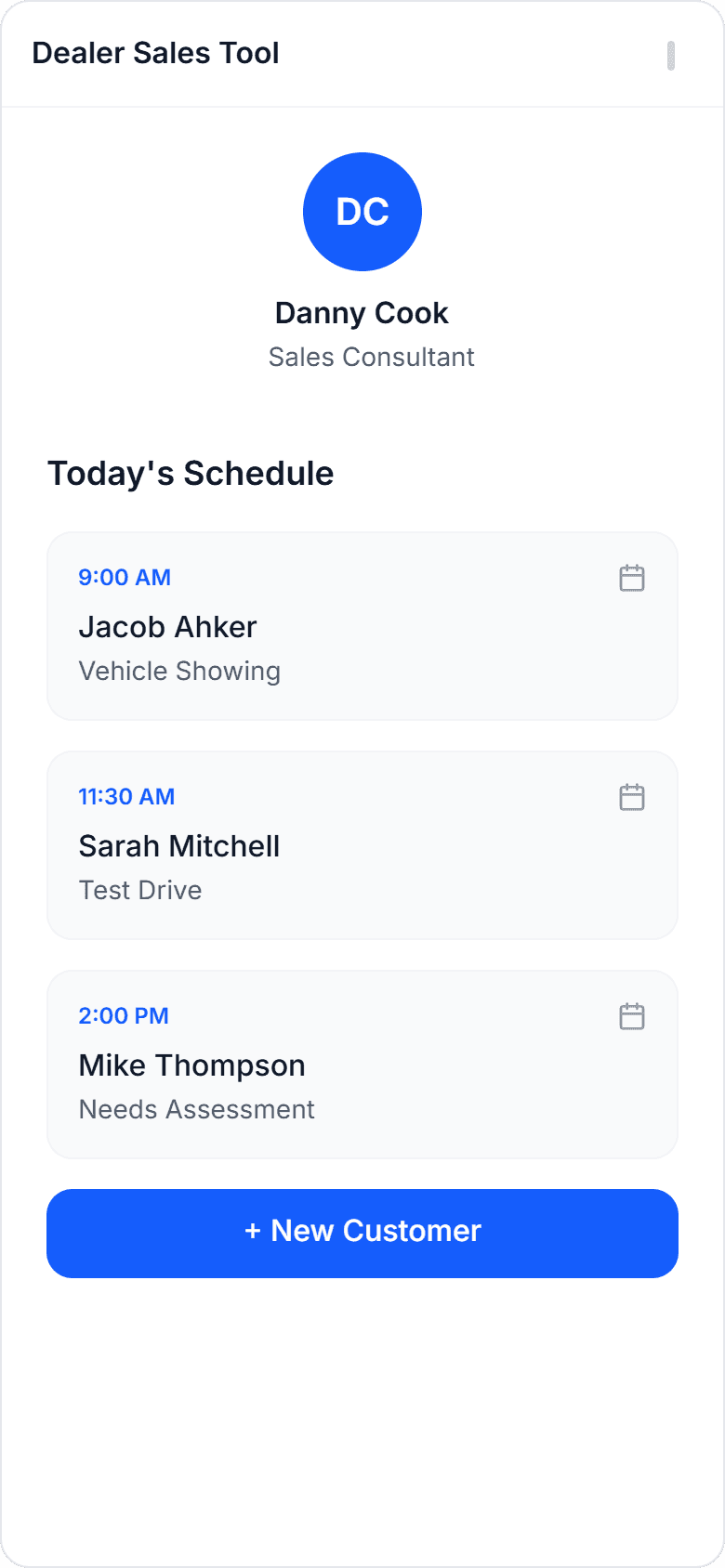
Appointment Listings

The Curated Homebase

Lead with active customers and appointments rather than inventory, reflecting how sales consultants actually work.

At-a-Glance Status

Prominent appointment count and quick-access customer cards enable rapid context switching during busy sales days.

Appointment Listings

Dealer Sales Tool

DC

Danny Cook

Sales Consultant

Today's Schedule

9:00 AM

Jacob Ahker

Vehicle Showing

11:30 AM

Sarah Mitchell

Test Drive

2:00 PM

Mike Thompson

Needs Assessment

+ New Customer

The Curated Homebase

Lead with active customers and appointments rather than inventory, reflecting how sales consultants actually work.

At-a-Glance Status

Prominent appointment count and quick-access customer cards enable rapid context switching during busy sales days.

research & Outcome

Design Validation Research

After developing the high-fidelity prototypes, I conducted qualitative research to validate design decisions and identify refinement opportunities before moving into development.

Research Methodology

Study Details

Sessions: 8 Remote Video Interviews

Length: 60 Minutes

Audience: 4 Sales Consultants & 5 Sales Managers

Objective

To validate and optimize a prototype designed to provide Salespeople with instant access to accurate, up-to-date, VIN-specific vehicle and incentive information, ensuring it effectively addresses their needs and pain points during customer interactions.

Synthesizing the Friction

To understand the challenges faced by sales staff and customers, I initiated a comprehensive synthesis of existing research. This approach allowed me to rapidly gain critical insights, build upon existing learnings, and avoid redundant foundational work.

To understand the challenges faced by sales staff and customers, I initiated a comprehensive synthesis of existing research. This approach allowed me to rapidly gain critical insights, build upon existing learnings, and avoid redundant foundational work.

VIN-Specific Features

The ability to quickly and easily access accurate, comprehensive, and VIN-specific information about Ford vehicles is a major pain point for dealerships. Current resources like the eSourceBook are proving to not be sufficient.

The Digital Window Sticker

Participants valued the idea of the tool acting as a "digital window sticker" but with more depth and interactivity. This means providing a clear breakdown of features, specifications, and packages that are on the vehicle, not just a generic list of possibilities.

Make Information Findable

No two customers are the same, a key requirement is the ability to quickly search for specific information within the tool to answer that one question a specific customer has.

Data Accuracy & Visual Aids

Trustworthy and accurate information was essential. Participants emphasized the value of having information "directly from Ford" to avoid misinformation. In the feature cards, participants liked the inclusion of visual aids, such as images or short videos, to demonstrate features or highlight their location on the vehicle.

Equipment Packages

Participants mentioned how difficult it was before to understand what's included in different equipment groups and packages.

Digital Needs Assessment

Participants reinforced the importance that the needs assessment as the foundational element of the sales process. The needs assessment serves to help understand customer needs and is crucial for tailoring the sales approach and finding the right vehicle for the customer.

Mind the Skill Gap

A common theme emerged that experienced salespeople often perform a needs assessment almost instinctively, while newer salespeople may find it more challenging. New salespeople often fall into oversharing too much information for example, an interactive tool would be beneficial for them and act as a training resource.

Systemizing the Process

There's interest in moving beyond informal note fields and "sticky notes" to a more systematized method of capturing and retaining customer preferences. The goal being to have this information highlighted and readily available throughout the sales process.

Customer Involvement Debate

There's a mix of opinions on whether the customer should directly interact with a needs assessment tool. Some believe it could be valuable for customers who are tech-savvy or not in-person, while others worry it would feel impersonal or overwhelming if customers are directly involved.

Customer Budget Debate

Requires further investigation, salespeople disagreed on which stage they brought the customer's price range or desired payment amount into the needs assessment.

Vehicle Comparison Tools

Participants highlighted the importance of comparison tools in helping customers understand the differences between vehicles and could replace their outdated reliance on window stickers.

High Value Placed on Comparison Tools

A recurring theme was the strong appreciation for comparison tools. Participants found value in the ability to directly compare vehicles, trims, and features side-by-side.

VIN-Specific Comparisons are Key

Participants lacked satisfactory solutions to compare vehicles at a VIN-specific level, as this provides the most accurate and relevant information for customers.

Highlighting Vehicle Differences

The ability to highlight key differences between vehicles was seen as a major time-saver and a way to help customers make informed decisions.

Comparing Across Model Years

The ability to compare vehicles across different model years was seen as valuable, particularly for Ford-to-Ford comparisons.

CRM & Integrations

Overall, Participants reinforced the importance of CRM systems for managing customer relationships and emphasized the need for seamless integration.

Data Redundancy Concerns

A major concern is the potential for data redundancy if a new tool doesn't integrate well with the existing CRM. Participants were very wary about the need to enter the same information in multiple systems on the day-to-day.

Limited Functionality in Some CRMs

Some Participants noted that their current CRM systems have limited functionality, particularly regarding needs assessments and detailed vehicle information.

Loss of Personal Touch

There's a concern that over-reliance on CRM data could lead to a less personalized sales approach, with salespeople simply following a script or checklist rather than building genuine rapport with customers.

Data Security and Privacy

Concerns were expressed about the security and privacy of customer data, especially if salespeople are using personal mobile devices to access CRM information.

VIN-Specific Features

The ability to quickly and easily access accurate, comprehensive, and VIN-specific information about Ford vehicles is a major pain point for dealerships. Current resources like the eSourceBook are proving to not be sufficient.

The Digital Window Sticker

Participants valued the idea of the tool acting as a "digital window sticker" but with more depth and interactivity. This means providing a clear breakdown of features, specifications, and packages that are on the vehicle, not just a generic list of possibilities.

Make Information Findable

No two customers are the same, a key requirement is the ability to quickly search for specific information within the tool to answer that one question a specific customer has.

Data Accuracy & Visual Aids

Trustworthy and accurate information was essential. Participants emphasized the value of having information "directly from Ford" to avoid misinformation. In the feature cards, participants liked the inclusion of visual aids, such as images or short videos, to demonstrate features or highlight their location on the vehicle.

Equipment Packages

Participants mentioned how difficult it was before to understand what's included in different equipment groups and packages.

Vehicle Comparison Tools

Participants highlighted the importance of comparison tools in helping customers understand the differences between vehicles and could replace their outdated reliance on window stickers.

High Value Placed on Comparison Tools

A recurring theme was the strong appreciation for comparison tools. Participants found value in the ability to directly compare vehicles, trims, and features side-by-side.

VIN-Specific Comparisons are Key

Participants lacked satisfactory solutions to compare vehicles at a VIN-specific level, as this provides the most accurate and relevant information for customers.

Highlighting Vehicle Differences

The ability to highlight key differences between vehicles was seen as a major time-saver and a way to help customers make informed decisions.

Comparing Across Model Years

The ability to compare vehicles across different model years was seen as valuable, particularly for Ford-to-Ford comparisons.

Digital Needs Assessment

Participants reinforced the importance that the needs assessment as the foundational element of the sales process. The needs assessment serves to help understand customer needs and is crucial for tailoring the sales approach and finding the right vehicle for the customer.

Mind the Skill Gap

A common theme emerged that experienced salespeople often perform a needs assessment almost instinctively, while newer salespeople may find it more challenging. New salespeople often fall into oversharing too much information for example, an interactive tool would be beneficial for them and act as a training resource.

Systemizing the Process

There's interest in moving beyond informal note fields and "sticky notes" to a more systematized method of capturing and retaining customer preferences. The goal being to have this information highlighted and readily available throughout the sales process.

Customer Involvement Debate

There's a mix of opinions on whether the customer should directly interact with a needs assessment tool. Some believe it could be valuable for customers who are tech-savvy or not in-person, while others worry it would feel impersonal or overwhelming if customers are directly involved.

Customer Budget Debate

Requires further investigation, salespeople disagreed on which stage they brought the customer's price range or desired payment amount into the needs assessment.

CRM & Integrations

Overall, Participants reinforced the importance of CRM systems for managing customer relationships and emphasized the need for seamless integration.

Data Redundancy Concerns

A major concern is the potential for data redundancy if a new tool doesn't integrate well with the existing CRM. Participants were very wary about the need to enter the same information in multiple systems on the day-to-day.

Limited Functionality in Some CRMs

Some Participants noted that their current CRM systems have limited functionality, particularly regarding needs assessments and detailed vehicle information.

Loss of Personal Touch

There's a concern that over-reliance on CRM data could lead to a less personalized sales approach, with salespeople simply following a script or checklist rather than building genuine rapport with customers.

Data Security and Privacy

Concerns were expressed about the security and privacy of customer data, especially if salespeople are using personal mobile devices to access CRM information.

Impact on Final Design

These research findings directly informed our product roadmap and feature prioritization:

Business & Data: Prioritized VIN-specific features lookup as the MVP feature, requiring new investments into Fords Data Structure

Engineering & Integration: Highlighed CRM integration as a critical technical requirement to avoid data redundancy, prioritizing technical feasibility.

Design & Strategy: Prioritizing digital needs assessment and collaboration with junior sales staff to balance the research conducted with senior staff.

conclusion

From Validation to Velocity

The initial research successfully proved that a mobile "Source of Truth" could solve the primary friction point for dealership sales teams. However, given the independent nature of the dealer network, the next phase of the project focused on de-risking the technical integration and scaling the impact.

The Path to MVP

Our goal was to move beyond the interface and into delivery, partnering with data and engineering focusing on three strategic pillars:

Deep CRM & Data Integration: Mapping critical workflows to identify exactly what data needs to pass between the DST and the Dealership Management Systems. Researching API capabilities to ensure a seamless integration that didn't add to the salesperson's administrative load.

Advanced Sales Intelligence: Moving toward dynamic, AI-powered comparisons that can bridge cross-model and cross-year data instantly. Refining how the Needs Assessment tool filters inventory so that salespeople are only shown the most relevant units for their specific customer.

Human-Centered Scaling: Conducting sessions with both veteran and novice salespeople to understand how the tool needs to adapt to different levels of expertise. Partnering with select dealerships to validate the prototype in the high-pressure environment of a live sales floor.

This project didn't just design a new app, it identified and began to solve a systemic failure in how data reached the frontline. By focusing on VIN-specific accuracy and CRM integration, we moved the needle from a concept to a mission-critical business tool.